


Countries across multiple regions have tightened travel measures or increased health screening as the Ebola outbreak in the DRC and Uganda continues to expand.
Governments introduce entry bans, border controls and enhanced screening as Ebola cases rise in the DRC and Uganda.
Countries across several regions have introduced travel restrictions and strengthened health controls in response to a growing outbreak of the Bundibugyo strain of Ebola in the Democratic Republic of the Congo (DRC) and Uganda, while international health agencies work to contain the spread of the virus.
The World Health Organization (WHO) has recorded 900 suspected cases and 220 suspected deaths linked to the outbreak in the DRC since authorities declared the epidemic on May 15. Uganda has confirmed five cases and one death.
Although WHO last week raised its national risk assessment for the DRC from high to very high, it continues to assess the global risk posed by the outbreak as low.
Authorities in both affected countries have implemented measures aimed at slowing transmission.
The DRC’s Ministry of Transport and Communications suspended flights to and from Bunia, one of 11 health zones affected by the outbreak. Humanitarian, medical and emergency flights may continue operating with special authorization.
Uganda has halted all direct flights with the DRC and suspended bus and boat crossings along the border for four weeks. Weekly markets in border districts have also been paused, although freight transport and the movement of food and other essential goods remain permitted.
Ebola Measures at a Glance
- DRC: Flights to and from Bunia suspended, with exemptions for humanitarian, medical and emergency operations.
- Uganda: Direct flights with the DRC suspended; border bus and boat crossings halted for four weeks.
- Canada: 90-day entry ban for residents of the DRC, Uganda and South Sudan; quarantine requirements for recent travelers from affected areas.
- Bahamas: 30-day entry restrictions for residents of the DRC, Uganda and South Sudan.
- United States: Entry ban for non-citizens and green card holders who recently traveled to affected countries; enhanced screening at designated airports for returning U.S. citizens.
- Jordan: Entry suspended for travelers arriving from the DRC and Uganda.
- Bahrain: 30-day entry ban on foreign travelers arriving from South Sudan, the DRC and Uganda.
- India: Enhanced airport screening, travel advisory, postponement of the India-Africa summit and cancellation of an International Big Cat Alliance meeting.
- Thailand: Travelers from the DRC and Uganda may enter only through Bangkok’s Suvarnabhumi Airport and must test negative on arrival.
- Mexico: Increased Ebola screening measures at airports.
No Ebola cases have been reported in Canada, the Bahamas, the United States, Jordan or Bahrain.
Other governments have opted to strengthen screening procedures rather than impose outright travel bans, reflecting different approaches to balancing public health concerns and international mobility.
WHO Warns Outbreak Is Outpacing Response Efforts
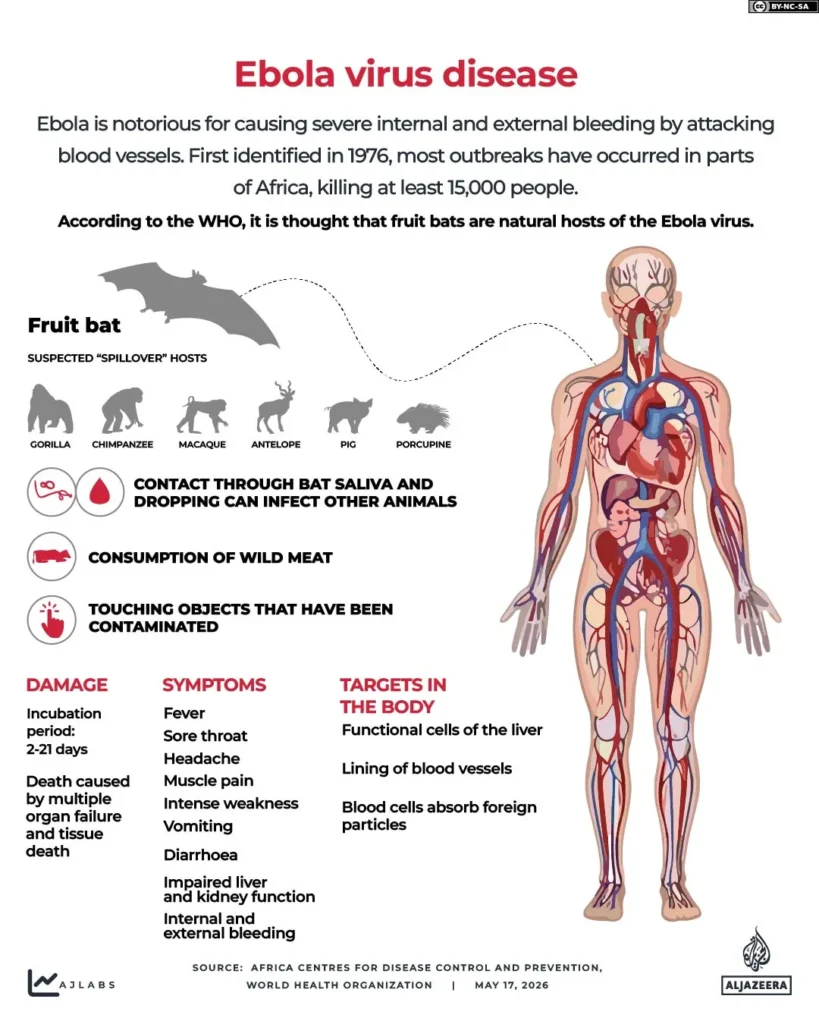
Health authorities say the Bundibugyo strain spreads through close contact with infected bodily fluids, contaminated objects or the remains of infected individuals. Measures that reduce physical contact therefore remain central to containment efforts.
WHO Director-General Tedros Adhanom Ghebreyesus said the response includes contact tracing, the establishment of treatment centers and infection prevention measures, but warned that delayed detection has complicated efforts to control the outbreak.
“The delay in detecting the outbreak means that we are now playing catch-up with a very fast-moving epidemic. We are urgently scaling up operations, but at the moment, the epidemic is outpacing us.”
Despite the challenges, Tedros expressed confidence that the outbreak can be brought under control.“But we know this virus, and we know how to stop it. We have stopped every previous Ebola outbreak, and we will stop this one, too.”
The United Nations and the International Civil Aviation Organization (ICAO) have urged governments and airlines to follow international health protocols developed during the COVID-19 pandemic rather than broadly restricting travel and trade.
ICAO said international flights remain safe and recommended exit screening for departing passengers in affected countries rather than entry screening for arrivals.
“Exit screening can be implemented in affected countries for all persons at international airports for unexplained illness associated with fever and consistent with other symptoms of potential BVD,” the organization said.
According to a report by The Wall Street Journal, the Trump administration is expected to deploy U.S. public health officers to Kenya to staff a potential quarantine facility for Americans exposed to the virus, considered at high risk of infection or who have already tested positive.
As the outbreak continues to evolve, governments are pursuing a range of responses, from border restrictions to enhanced health screening, while international health agencies maintain that targeted containment measures remain the most effective tool for preventing further spread.
Author: MK
Source: Al Jazeera


0 Comentarios